
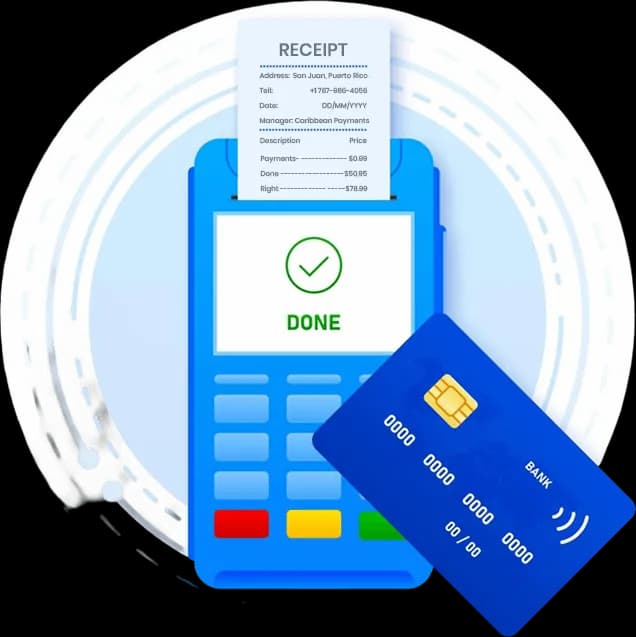
Every time you accept a card, a small slice of the sale is split among several companies before the money reaches your bank account. That slice is what people mean by credit card processing fees. It looks like one number on your statement, but it is really three separate costs stacked together. Understanding those three parts is the single best way to tell whether you are paying a fair rate — or quietly overpaying every month.
The three parts of every processing fee
No matter which processor you use, your total cost is built from the same three components:
- Interchange— paid to the bank that issued your customer’s card. This is the largest piece, and it is set by the card networks. Every processor pays the exact same interchange, so it is the true, non-negotiable floor of your cost.
- Assessments — small network fees paid to Visa, Mastercard, Discover, or American Express for use of their rails. These are a fraction of a percent and, like interchange, are the same for everyone.
- Processor markup — what your provider charges on top of the two costs above for authorization, settlement, support, and equipment. This is the only part that is negotiable, and it is where providers compete — or hide margin.
Because interchange and assessments are fixed, any two processors quoting different prices are really just charging different markups. That is the number to focus on.
Pricing models: flat, interchange-plus, and tiered
Providers package those costs into one of three pricing structures, and the structure matters as much as the rate itself:
- Flat rate— one blended percentage (and often a small per-transaction fee) on everything, such as 2.6% + 10¢. Simple and predictable, but you overpay on low-cost cards because the processor keeps the difference.
- Interchange-plus— you pay the real interchange and assessments, plus a fixed, disclosed markup like 0.30% + 10¢. The most transparent model and usually the cheapest for established businesses, because you see exactly what the processor earns.
- Tiered— transactions are sorted into “qualified,” “mid-qualified,” and “non-qualified” buckets at rates the processor defines. It looks cheap on the headline tier but is the least transparent, and rewards cards quietly land in the pricier buckets.
Typical rates
As a rough benchmark, interchange usually runs between about 1.3% and 2.4% depending on the card, assessments add roughly 0.13% to 0.15%, and a competitive processor markup on interchange-plus is often around 0.20% to 0.50% plus a small per-item fee. Add it up and most small businesses land at an effective rate of 2.5% to 3.5%. Rewards and corporate cards push the number higher; debit and card-present sales pull it lower.
Hidden fees to watch for
The headline rate is rarely the whole story. Scan your statement for these common add-ons:
- Monthly minimums, statement fees, and PCI-compliance charges.
- Batch or settlement fees applied each time you close out.
- Non-qualified surcharges on rewards cards under tiered pricing.
- Chargeback, retrieval, and address-verification (AVS) fees.
- Annual, gateway, and early-termination fees buried in the contract.
How to lower your processing costs
You cannot change interchange, but you can shrink almost everything else:
- Switch to interchange-plus so the markup is visible and fixed.
- Take payments card-present — a dipped or tapped card qualifies for lower interchange than a keyed-in one.
- Batch out daily so transactions settle at the best rate.
- Keep equipment and software PCI-compliant to avoid non-compliance charges.
- Review a real statement with a provider who will name every fee.
Notes for Puerto Rico merchants
Puerto Rico runs on the same Visa and Mastercard rails as the U.S. mainland, so interchange and assessments are identical here. What differs is service: a mainland call center rarely understands the way local businesses sell, and a vague quote is hard to challenge from the island. Working with a local processor means a real person can pull your statement, translate the line items, and build pricing around how you actually operate. Explore our full range of payment solutions to see how transparent, locally supported processing fits your business.